









What Happens to Your Business When You’re Unavailable
Most small businesses look stable from the outside. Calls are coming in. Work is going out. Customers are generally happy. But many of these businesses share the same quiet vulnerability: they only run smoothly when the owner is available.
In the early days, this is normal. The owner is the switchboard, the estimator, the scheduler, and the problem-solver. Context lives in one head, and that makes decisions fast. Customers often like it, too, because they feel close to the person who “makes it happen.”
The trouble is what happens when that early-stage pattern becomes permanent. The owner stays at the center of everything, not because they’re controlling, but because the business has never built an operating system that can carry the load without them. What started as agility becomes fragility.
Absence is the most honest stress test
There is a simple way to discover whether your business is built on systems or on personal effort: step away.
Not for a month. Not forever. Just for 48 hours. Take a day where you don’t answer calls, don’t check texts, don’t manage the schedule, and don’t fix the little problems as they appear. If the idea of doing that makes your stomach tighten, the business is telling you something.
Absence exposes the system you actually have. Where do calls go? Who sees incoming messages? Does anyone have the context to respond without guessing? Are leads captured and routed, or do they depend on you noticing them? Can a team member pick up a customer conversation without asking the customer to repeat everything?
If the answers are fuzzy, the business isn’t resilient. It’s coasting on the owner’s attention.
Continuity isn’t redundancy. It’s design.
“Business continuity” can sound like a corporate concept, the kind of thing that belongs in a binder with emergency plans and acronyms. In small business reality, continuity is simpler: it’s the ability for the business to continue responding and following through even when one person is unavailable.
That doesn’t require a second owner. It requires fewer single points of failure.
Most owner-dependency problems show up in the same places:
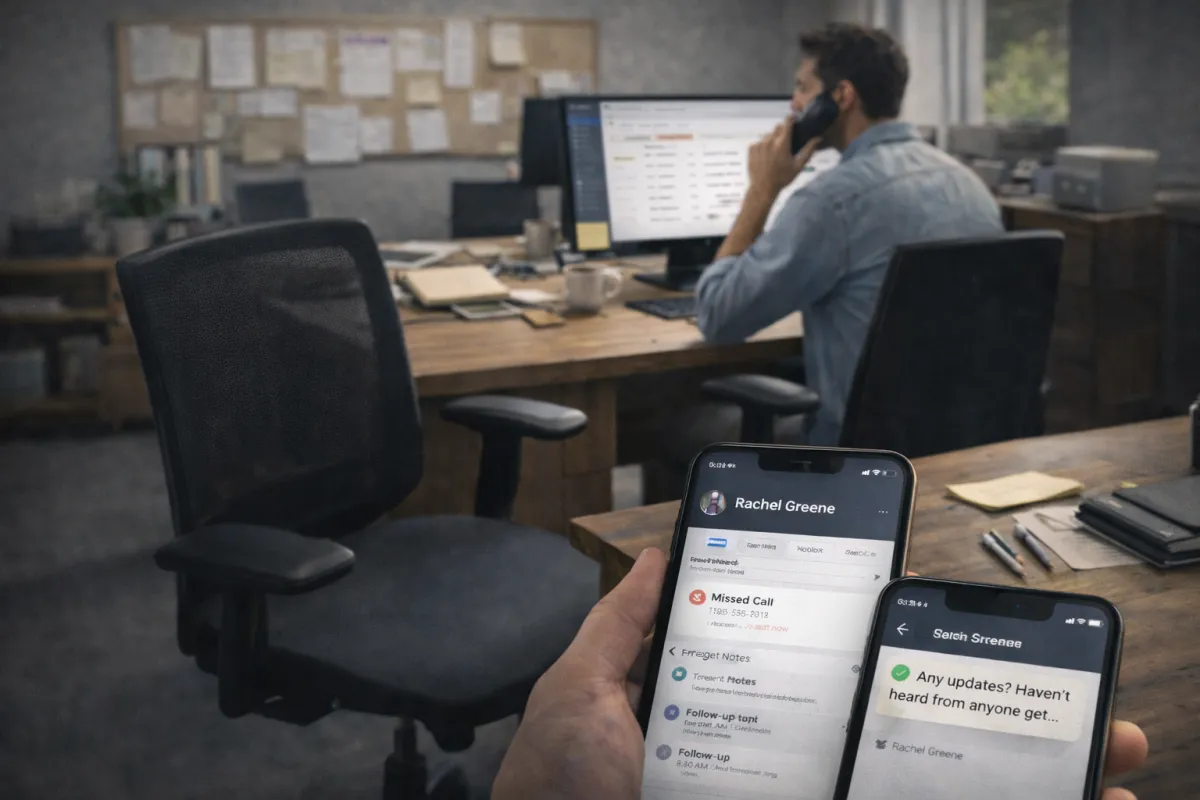
Communication lives on personal devices. Calls and texts are tied to one phone.
Customer history is scattered. Notes are in inboxes, texts, or someone’s memory.
Processes are implied, not defined. People “kind of know” what to do.
Ownership is unclear. Everyone assumes someone else will follow up.
When these are true, stepping away feels risky because it is risky. The business doesn’t have a shared nervous system.
Customers feel inconsistency before you do
Owners often assume the risk of owner-dependency is personal. “I can’t take time off.” That’s true, but the more damaging effect is external: customer experience becomes inconsistent.
Customers don’t know you were in the field. They don’t know you were sick. They don’t know you were dealing with a family issue. They only experience the outcome: a call that went unanswered, a message that didn’t get acknowledged, a follow-up that didn’t happen when promised.
Those moments rarely create dramatic blow-ups. They create doubt. And doubt is expensive. It quietly increases price sensitivity and decreases patience.
What continuity looks like in practice
Continuity is built with a few unglamorous building blocks. None of them are complicated. They just require intention.
1) Shared visibility into communication
If communication is trapped on personal devices, you don’t have continuity. You have a bottleneck. Shared visibility means that calls, texts, and inquiries land somewhere the business can see them. That allows a team member to respond, follow up, or escalate without waiting for the owner to surface.
2) A clear system of record
A system of record is simply one place where customer history lives. It doesn’t need to be perfect, but it must be consistent. When history is visible, the team can act with confidence. Without it, every handoff turns into a game of telephone.
3) Predictable handoffs
Most operational friction comes from handoffs. Someone takes a message. Someone else interprets it. A third person calls back with no context and asks the customer to repeat everything. Predictable handoffs reduce that friction. They also reduce the owner’s role as translator and traffic controller.
4) Automation for the predictable, humans for the nuanced
Continuity doesn’t mean automating the soul out of the business. It means automating the predictable moments: confirmations, acknowledgements, routing, reminders, internal notifications. These are not relationship moments. They are reliability moments.
Humans keep the human work: judgment, empathy, negotiation, and problem-solving. Continuity is about protecting human attention from doing robot tasks.
The “freedom” indicator
A remarkably accurate measure of operational maturity is whether the business can function when the owner is unavailable. Not perfectly. Not at full speed. But competently—responding, tracking, and following through.
That capability protects revenue, but it also protects people. It reduces stress on the team. It reduces emergency scrambling. It reduces the owner’s risk of burnout, which is often the hidden limiter on growth.
This is a common reason businesses turn to Honeytree. They’re not asking for more apps. They’re asking for fewer failure points. The work is usually about building shared visibility, predictable handoffs, and systems that keep the business responsive even when the owner is not immediately available.
Continuity doesn’t make the owner less important. It makes the business less fragile. And that’s what stability looks like.


