



Facebook Page or Your Own Website: Which Does Your Business Really Need?
For many small business owners, one of the first digital marketing questions is deceptively simple:
“Do I really need a website if I already have a Facebook page?”
The short answer is: it depends—but relying on only one is usually limiting.
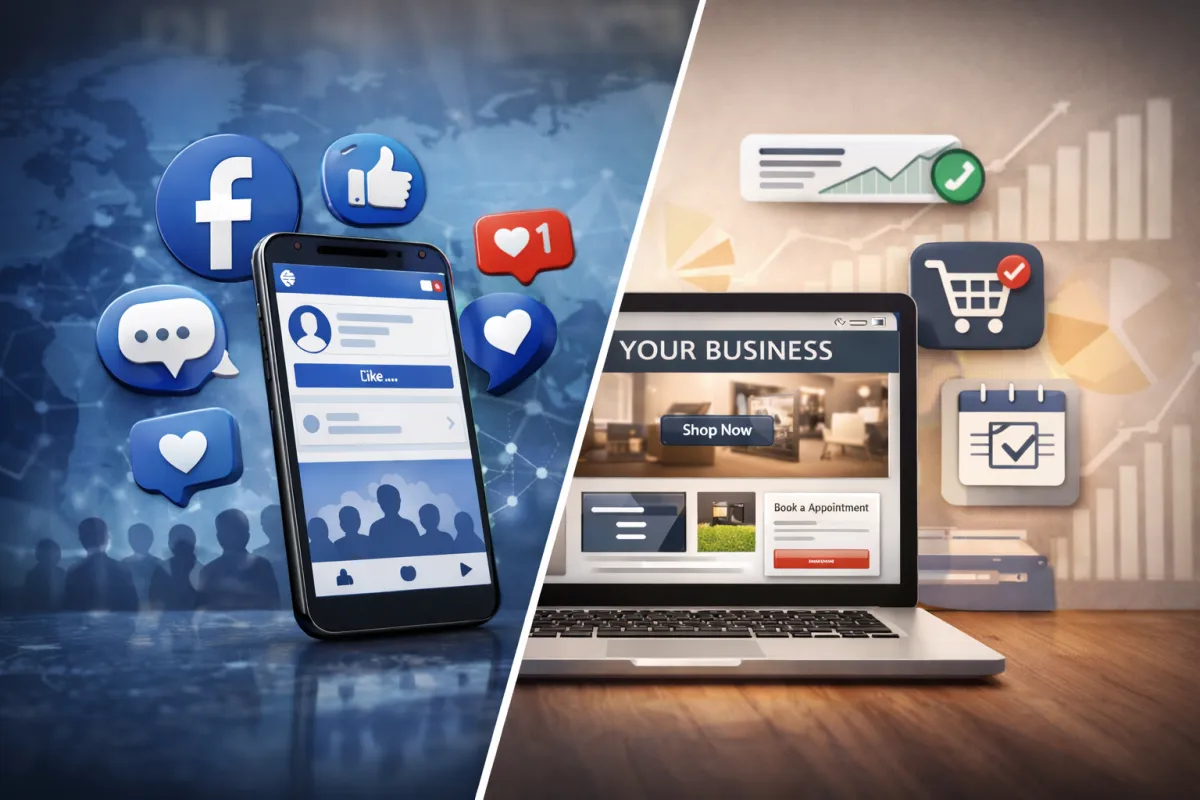
Facebook and your own website serve very different roles. When used together, they create a stronger, more resilient online presence. When used in isolation, each comes with trade-offs that can slow growth or reduce control.
Let’s break it down clearly.
The Case for Facebook: Accessible, Familiar, and Fast
For many small businesses, Facebook is the first step into an online presence—and for good reason.
Advantages of Using Facebook
1. Low barrier to entry
Creating a Facebook business page is free, quick, and requires no technical knowledge. You can be visible online within minutes.
2. Built-in audience
Facebook already has billions of users. Your customers are likely already there, which makes discovery, sharing, and engagement easier—especially for local and service-based businesses.
3. Social proof and engagement
Reviews, comments, likes, and shares act as instant credibility signals. For early-stage businesses, this can be powerful validation.
4. Integrated messaging and ads
Facebook Messenger, comments, and advertising tools allow direct communication and promotion without additional platforms.
Limitations of Facebook
1. You don’t own the platform
Your page exists at Facebook’s discretion. Algorithm changes, policy updates, or account restrictions can dramatically impact your visibility—or remove it entirely
2. Limited customization and functionality
You’re confined to Facebook’s layout, features, and rules. Advanced forms, automations, bookings, or custom user journeys are difficult or impossible to implement properly.
3. Distraction-heavy environment
Your business competes with ads, memes, and other content. Visitors are only one scroll away from leaving your page.
Facebook is an excellent entry point, but it’s not a platform you fully control.
The Case for Your Own Website: Control, Authority, and Scalability
A website is your digital home base. It’s the one place online where you set the rules.
Advantages of Having Your Own Website
1. Full ownership and control
Your website belongs to you. You decide the design, content, functionality, and how visitors move through it.
2. Stronger credibility and professionalism
A well-built website signals legitimacy. For many customers, it’s the difference between “side hustle” and “established business.”
3. Advanced functionality
Websites can support:
Lead capture forms
Appointment scheduling
Payment processing
Automation and CRM integrations
SEO for long-term discoverability
This is where real business systems live.
4. Long-term asset, not rented space
Unlike social platforms, a website grows in value over time through content, SEO, and optimization.
Limitations of a Website
1. Higher upfront investment
A quality website requires time, planning, and often professional support.
2. Traffic doesn’t come automatically
Unlike Facebook, a website needs intentional marketing (SEO, ads, social media) to bring people in.
A website is powerful—but without traffic sources, it can sit idle.
The Smart Approach: Facebook and a Website, Working Together
This is where most businesses go wrong—not by choosing the “wrong” platform, but by choosing only one.
How They Work Best Together
Facebook acts as the front door
It’s where people discover you, engage casually, and build familiarity.
Your website is the control center
It’s where leads are captured, trust is deepened, and conversions happen.
Facebook drives attention.
Your website turns attention into structured action.
This combination gives you both reach and reliability—visibility without sacrificing control.
So, Which Should You Prioritize?
New or very small businesses:
Facebook can be a strong starting point—but it shouldn’t be the end goal.
Growing businesses:
A website becomes essential for credibility, automation, and scalability.
Established businesses:
Facebook supports marketing, but your website should be the backbone of your digital presence.
The question isn’t Facebook or a website. It's how intentionally they’re connected.
Final Thoughts
Facebook is an accessible, powerful platform—especially for small businesses getting started. But it’s borrowed ground.
A website provides control, flexibility, and long-term stability—but needs traffic and strategy to perform.
Used together, they create a balanced digital ecosystem:
Facebook brings people in
Your website guides them forward
At Honeytree, we help businesses build systems where every tool has a purpose—and nothing is left to chance.
Because visibility is good... but control is better.


