







The Real Cost of “Free” Software for Small Businesses
“Free” is one of the most persuasive words in small business technology. It feels responsible. It feels disciplined. It feels like you’re not getting taken for a ride.
And sometimes, early on, free tools do help. They get you started. They let you move without asking permission from a budget. They let you test an idea before you commit.
The trouble is that “free” doesn’t mean “no cost.” It usually means the cost shows up later, in forms that don’t look like a bill.
In a small business, the most expensive resource is rarely software spend. It’s attention. It’s time. It’s the owner’s ability to focus on revenue-producing work instead of keeping the lights on technologically.
Free tools tend to siphon attention in quiet ways.
Free usually means limited support
When something breaks in a paid system, you can often reach a human being. You can escalate. You can hold someone accountable. With many free tools, the support model is “self-serve.” That’s fine until it isn’t.
When your phone routing is down, when emails aren’t landing, when a form stops submitting, the business doesn’t get to wait patiently while you search forums. Customers don’t care that the tool is free. They just experience the failure as your failure.
Owners often absorb these moments late at night or early in the morning. Not because they enjoy it, but because the business can’t afford downtime. That’s the first hidden cost: the unpaid labor required to keep free tools working.
Free tools change terms without asking you
Paid software changes too, but paying customers tend to get clearer communication, roadmaps, release notes, and in many cases the ability to plan. Free tools can shift unexpectedly. Features get moved behind a paywall. Limits tighten. Integrations break. UI changes cause confusion for staff. The system you “trained” yourself and your team on quietly becomes a different system.
That instability creates operational drag. It forces re-learning. It forces workarounds. And it often forces you to adopt a second tool to patch the first.
Free can create serious data and continuity problems
Small businesses rarely think about data ownership until they need it. They assume they can export what they need and move on.
In practice, migrations are messy. Some tools export only part of your history. Others export in formats that require cleanup. Some don’t export the most valuable thing of all: context.
Context is the difference between “this person contacted us” and “this person contacted us, asked for X, was quoted Y, had concerns about Z, and prefers texting.” When you lose context, you don’t just lose data. You lose momentum.
Free tools also tend to encourage personal, ad-hoc usage. One person signs up for an account, and suddenly the business’s customer history lives inside one person’s login. That’s a continuity risk, not a convenience.
Deliverability and reputation aren’t optional
Email is a good example of how “free” can become expensive. Most business owners don’t track deliverability. They assume that if they hit send, the message arrives.
But inbox placement is a real operational variable. If your business relies on confirmations, reminders, proposals, invoices, or follow-ups, deliverability is not a nice-to-have. It is the communication backbone of the business.
When a free email setup gets flagged, when authentication isn’t configured, when messages begin landing in spam, you don’t always get an obvious warning. The system still “works” from your perspective. The customer just doesn’t receive it. And now you’re chasing ghosts.
The cost shows up as missed appointments, delayed payments, and “I never got that” conversations that drain goodwill.
The migration tax is real
Free tools feel low-risk because you can always switch later. The catch is that switching later is rarely easy.
By the time you outgrow a free tool, it’s usually embedded in your workflows. Your staff has habits. Your customers have expectations. Your automations—if you’ve built them—depend on it. Even if the tool is objectively a poor fit, changing it feels disruptive. So businesses delay.
That delay is expensive. You keep operating on a shaky foundation because rebuilding feels like too much. This is how small businesses get stuck with technology they don’t trust.
So what should you do?
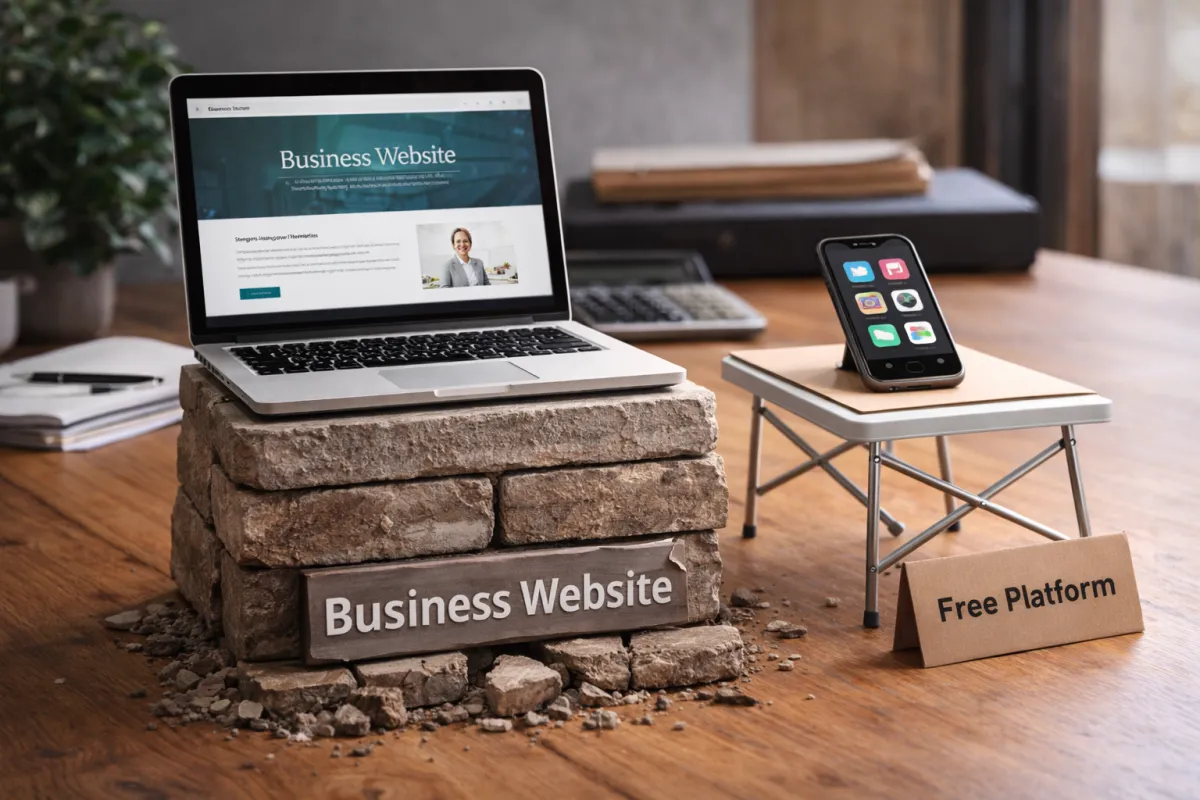
Free tools can still be useful—when you use them deliberately. The key is to treat them as temporary scaffolding, not as core infrastructure.
Ask a few grounded questions before adopting anything “free” as a system of record:
What happens when this breaks? Who helps, how fast, and what does downtime cost us?
Who owns the account? Is this tied to a person, or to the business?
Can we export everything that matters? Not just contacts, but history and context.
Does this support how we operate? Or are we adapting our business to the tool?
As the business matures, the calculation changes. You stop optimizing for “cheapest.” You start optimizing for “most reliable.”
Paid systems aren’t about luxury. They’re about accountability. They’re about reducing surprise. They’re about buying back time and protecting customer experience.
Free feels responsible at the beginning. A stable foundation is responsible for the long haul.


